
A VCE study score is a rank inside one subject, from 0 to 50, set so that the average is always 30: a 30 puts your child about in the middle of everyone who took that subject, a 35 in roughly the top quarter and a 40 in the top 9%. VTAC then scales each study score to adjust for how strong that subject’s students were, adds English plus the next best three scaled scores and 10% of a fifth and sixth, and turns the total into the ATAR, which is a rank against the whole age group, not a mark out of 100. On 2025’s numbers, six study scores of 30 in a common mix of subjects come to an ATAR of about 75.
VCE results and ATARs for 2026 are released at 7am on Thursday 10 December. This page is for the parent who will be looking at the screen with their child that morning: what each number on the results means, why the same 30 is worth different amounts in different subjects, a worked example from VTAC’s own 2025 tables, the five misreadings that cause the most unnecessary panic, and the two days afterwards when course preferences can still change.
Three numbers, two organisations
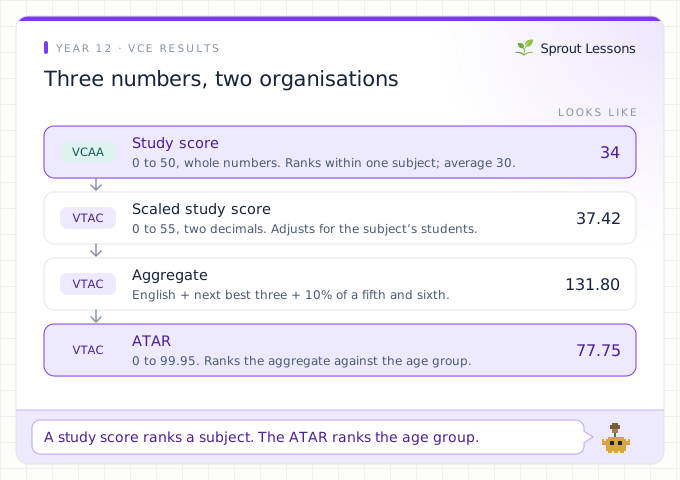
The results come from two bodies, and the quickest way to tell them apart is the decimal point. The VCAA (Victorian Curriculum and Assessment Authority) runs the VCE and issues the Statement of Results: for each Unit 3 and 4 subject, an S or N for each unit, a letter grade from A+ to E for each of the three graded assessments (UG means the score was too low for a grade, NA means the task or exam was not done), and one study score out of 50. Study scores are whole numbers.
VTAC (the Victorian Tertiary Admissions Centre) takes those study scores, scales them, and calculates the ATAR. Scaled scores and the ATAR both have decimal points. So a “34” is a VCAA study score, a “37.42” is a VTAC scaled score, and a “78.35” is an ATAR.
What a study score actually measures
A study score is not a percentage of marks. The VCAA takes the three graded assessments in a subject (usually school-assessed coursework or tasks plus the exam), standardises each one against the state, weights them (in English, Unit 3 coursework is 25%, Unit 4 coursework 25% and the exam 50%), adds them up, and ranks every student in Victoria who took that subject. The ranks are then placed on a curve with an average of 30 and a standard deviation of 7, cut off at 0 and 50. Most study scores fall between 23 and 37.
The VCAA publishes roughly where each score sits, for subjects with 1000 or more students:
- 45: about the top 2% of the subject.
- 40: about the top 9%.
- 35: about the top 26%.
- 30: about 53% scored this or higher, so this is the middle.
- 25: about 78% scored this or higher.
- 20: about 93% scored this or higher.
Two consequences for reading your child’s results. First, a 30 is not a bare pass: it is the middle of the state in that subject. Second, a study score needs at least two of the three graded assessments and an S for both Unit 3 and Unit 4 in the same year. A subject shown without a study score usually means one of those was missing, not that the score was too low to print.
What about a tough school, or a harsh SAC marker? School-assessed coursework is statistically moderated before it counts. For each school’s group in a subject, the VCAA lines up the spread of SAC scores with how that same group did on the exam. Your child’s place in the school’s order stays the same, but the scores attached to that order move to match the group’s exam results. A SAC rank of third in a strong group is worth more than third in a weak one, whatever the raw SAC marks were.
Scaling: why the same 30 is worth different amounts
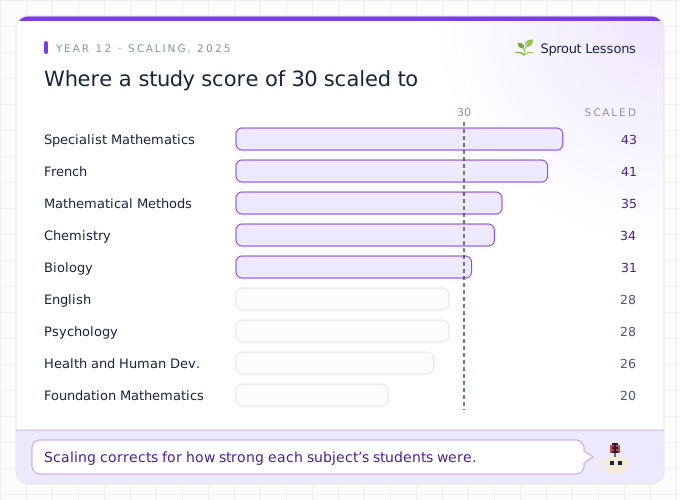
A 30 in Specialist Mathematics and a 30 in Psychology are both the middle of their subject, but the students in Specialist are, on average, stronger across all their other subjects. VTAC corrects for that. It compares how each subject’s students performed in their other subjects, and moves the whole subject up or down so that the middle of one subject is worth the same as the middle of another. The result is a scaled study score from 0 to 55.
VTAC is explicit that this is about the competition in a subject, not the subject being harder or easier. Two extra rules sit on top. The four maths subjects (Foundation, General, Methods and Specialist) are also scaled against each other, and each gets the higher of the two results. And every language has five added to its scaled average as a matter of government policy, which is worth about five points at a study score near 30 and less further from it.
The trap is reading the bar chart as advice. VTAC’s own scaling guide calls choosing a subject because it scales well a myth that “can work against you”. On the 2025 numbers, a 25 in Mathematical Methods scaled to 28 and a 35 in Health and Human Development scaled to 31. A subject your child is good at and engaged in almost always beats one they picked for its scaling. Our page on choosing General, Methods or Specialist covers the maths choice itself.
From scaled scores to the ATAR: a worked example
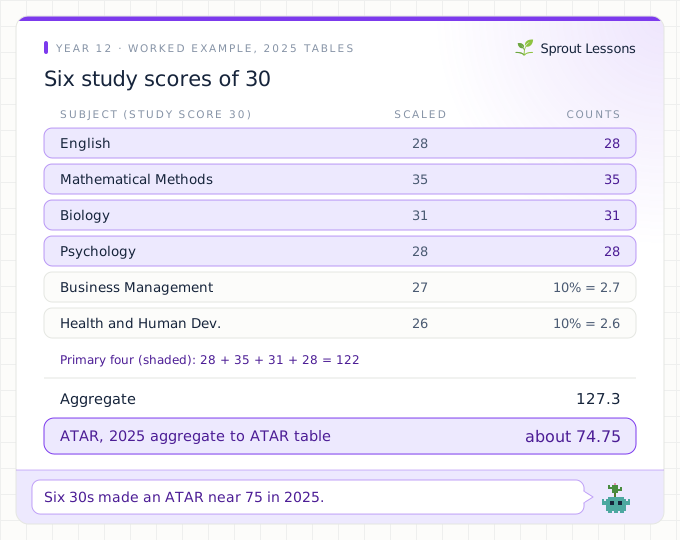
VTAC builds an aggregate from the scaled scores. The “primary four” are the best scaled score from the English group (English, English as an Additional Language, English Language or Literature) plus the next three best. Then up to two increments are added, usually 10% of the fifth and sixth scaled scores. No more than two subjects from the same study area (two maths, say) can count in the primary four, and no more than three overall.
Take a student with a study score of 30 in English, Mathematical Methods, Biology, Psychology, Business Management and Health and Human Development. Using the 2025 scaled scores (rounded, as VTAC publishes them), the primary four are 28 + 35 + 31 + 28 = 122. Business Management adds 10% of 27, and Health and Human Development 10% of 26: an aggregate of about 127.3. In VTAC’s 2025 aggregate to ATAR table, that is an ATAR of about 74.75.
Now take a second student with a 30 in English, General Mathematics, Psychology, Business Management, Health and Human Development and Physical Education. The primary four are 28 + 28 + 28 + 27 = 111, the increments add 5.3, and the aggregate of about 116.3 is an ATAR of about 67. Same effort, same place in each subject, a different ATAR, because the subjects were full of different students. That is exactly what scaling is for, and it is also why ATARs from different subject mixes cannot be compared by looking at study scores alone. The real calculation uses scaled scores to two decimal places and the 2026 tables, so treat these as close, not exact.
Why does the middle of every subject come to an ATAR in the 70s rather than 50? Because the ATAR ranks your child against their whole age group, including everyone who did not finish Year 12 or did not take an ATAR route. An ATAR of 75.00 means your child’s results were above 75% of that age group. In the 2025 table, an ATAR of 50.00 needed an aggregate of about 94, 70.00 about 120, 80.00 about 136 and 90.00 about 155. The top ATAR, 99.95, needed about 211.
Five misreadings that cause the most panic
1. “An ATAR of 70 means 70%”
It is a rank, not a mark. 70.00 means your child finished ahead of 70% of their age group. There is no pass or fail ATAR, and VTAC is direct about it: everyone who receives an ATAR has passed the VCE. ATARs below 30 are shown as “less than 30”.
2. “A 30 is a pass mark”
A study score of 30 is the state average for that subject. A child with 30s across the board is in the middle of every subject they took, and on the 2025 tables that is an ATAR somewhere in the high 60s to mid 70s depending on the subjects.
3. “Their SAC marks were in the 80s, so why only a 29?”
SAC marks are moderated against the school group’s exam results, and the study score is a rank across the state, not an average of marks. High SAC marks at a school where the group then did less well on the exam come down; it is the rank inside the school that carries through.
4. “Their ATAR is below the course cut-off, so it’s gone”
There is no published cut-off set in advance. A course’s “lowest selection rank” is what the last offer went to the year before, after adjustments such as subject adjustment points and equity schemes (SEAS), which are added to the aggregate, not the ATAR. VTAC’s advice is to keep a course on the list even when the ATAR is below last year’s lowest selection rank, because the adjustments and next year’s competition may differ.
5. “They should drop the dream course to the bottom now”
Preferences are considered in order, and listing a long-shot course first costs nothing if it does not come through: VTAC moves on to the next one. Its advice is the dream course or courses at the top, realistic courses and pathway courses below, across up to eight preferences.
Results morning, and the two days after
The dates below are VTAC’s for current Victorian Year 12 students applying for courses that start in 2027. Check your child’s own VTAC account, because some courses close their preference lists earlier.
- Before 10 December: register on the VCE Results and ATAR website. It needs the VCAA student number, which is on your child’s school paperwork.
- Thursday 10 December, 7am: study scores, scaled scores and the ATAR appear on the website and app. If your child applied through VTAC, the ATAR also shows in their VTAC account. A digital ATAR statement follows on 15 December.
- Read in this order: any subject without a study score first (ask the school why the same day), then the study scores against the 30 and 40 marks above, then the ATAR.
- Saturday 12 December, 12 noon: the change of preference period for December round offers closes. That is about two days after results. Re-read the list with the ATAR in hand, but keep the dream course on it.
- Wednesday 23 December: December round offers. A further short window, from 10am on 23 December to 12 noon on 24 December, sets preferences for January round 1 offers on 12 January 2027.
If your child is in Year 10 or 11 and you are reading this early, the useful lesson is the opposite of chasing scaling: an ATAR route needs four study scores including English, so the decisions that matter most are VCE or VCE VM and which maths stays open.
Have a younger child heading for the VCE? Sprout builds Victorian Curriculum lessons for Years 9 and 10 around what your child loves, so Methods is still an option in Year 11. Try it free.
Where this sits
For choosing subjects before Year 11, see VCE or VCE VM and which VCE maths. For what a tutor can and cannot change at this level, see what a high-ATAR tutor buys. And for the reports that come before the VCE, our guide to the Victorian school report explains the A to E ratings from Prep to Year 10.
The short version
- A study score (VCAA, out of 50, whole numbers) ranks your child within one subject. The average is 30; 40 is about the top 9%.
- A scaled score (VTAC, up to 55, decimals) adjusts for how strong each subject’s students were.
- The aggregate is English plus the next best three, plus 10% of a fifth and sixth.
- The ATAR (0 to 99.95) ranks the aggregate against the whole age group. Six 30s came to about 75 in 2025.
- Results arrive at 7am on 10 December 2026; December round preferences close at 12 noon on 12 December.
Sprout makes lessons on the exact Victorian Curriculum code your child is working on, from Foundation to Year 10, set in their own interests. Start free.
How this page was checked
The study score method, the percentages for each score and the Statement of Results codes come from the VCAA’s score aggregation and interpreting the Statement of Results pages. Scaling, the aggregate rules and the ATAR definition come from VTAC’s results and ATAR page and its ATAR and Scaling Guide 2026. The scaled scores and the aggregate to ATAR conversions are from VTAC’s 2025 Scaling Report and 2025 Aggregate to ATAR Table, both dated 11 December 2025; the 2026 versions are published with the 2026 results. Dates are from VTAC’s key dates page for courses starting in 2027. Checked against the current rules as at 29 October 2026.
FAQ
What is a good VCE study score?
Study scores are set so the average in every subject is 30, with most scores between 23 and 37. For subjects with 1000 or more students, about 26% score 35 or higher, about 9% score 40 or higher and about 2% score 45 or higher. A 30 is the middle of the state in that subject, not a bare pass.
How is the ATAR calculated in Victoria?
VTAC scales each VCE study score, then adds the best scaled score from the English group, the next three best scaled scores, and 10% of a fifth and sixth. That aggregate is ranked against the whole age group to give an ATAR from 0 to 99.95. An ATAR of 75.00 means results above 75% of the age group.
What ATAR do you get with all 30s?
It depends on the subjects, because each is scaled differently. Using VTAC's 2025 tables, six study scores of 30 in English, Mathematical Methods, Biology, Psychology, Business Management and Health and Human Development made an aggregate of about 127 and an ATAR of about 75. The same six 30s with General Mathematics and less strongly scaled subjects came to about 67.
Should my child choose subjects that scale up?
No. VTAC calls it a myth that can work against students. Scaling adjusts for how strong a subject's students are, so a good score in a subject your child is good at usually beats a weaker score in one that scales up. In 2025, a 25 in Mathematical Methods scaled to 28 while a 35 in Health and Human Development scaled to 31.
When are VCE results released in 2026?
VCE study scores and ATARs are released at 7am on Thursday 10 December 2026 on the VCE Results and ATAR website and app, which needs the VCAA student number to register. For current Year 12 students, the VTAC change of preference period for December round offers closes at 12 noon on Saturday 12 December, and December round offers are made on 23 December.