
You do not need a workbook for summer holiday maths. A Victorian summer hands you the numbers: a cricket pitch is 20.12 metres long, low tide is at 14:37, two ice creams come to $8.72 and the drive to the coast is 240 km. One question a day, asked out loud at your child’s level, is enough. This page gives 27 of them, from Prep to Year 8, each matched to the Victorian Curriculum, and the four that children most often get wrong.
This is the talking half of holiday maths. The other half is a few minutes of written practice on this year’s facts and methods, and our page on how much practice a Victorian summer needs covers that, with the research. Term 4 ends on Friday 18 December 2026 and government school students go back on Thursday 28 January 2027, so there are about six weeks to play with and no need to start in the first two.
How to use the ladders
- Start at the level your child just finished. The Victorian Curriculum is written in levels, and Level 4 is roughly Year 4. A child who has just finished Year 4 starts on the Level 4 row.
- Ask it, then ask the one above. If the first is easy, the next row up is a fair stretch. If it is not, the row below is not an insult. It is where the answer is.
- No pen unless they want one. Explaining an answer out loud is the work here.
- One a day, and stop. A second question when they are enjoying it is fine. A second question because the first went badly is how maths gets a reputation.
The backyard pitch
The Laws of Cricket make a pitch 22 yards long, which is 20.12 metres, and an over is six balls. Those two facts carry a question for every level.
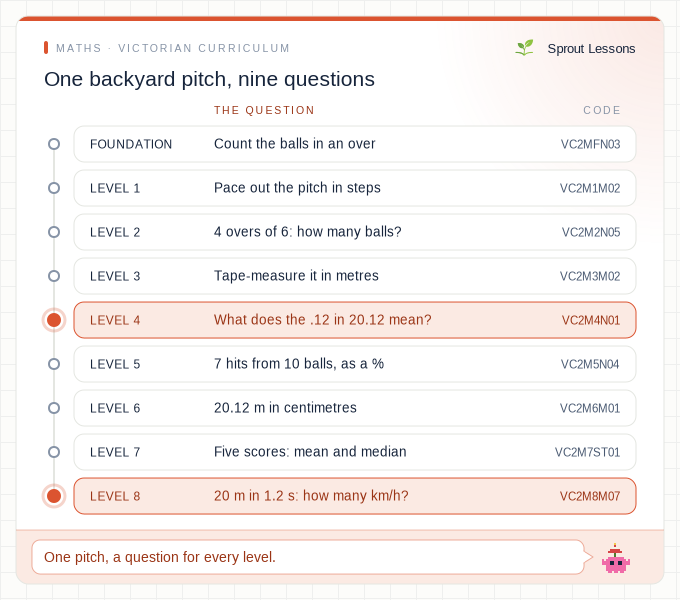
| Level | Ask | Answer | Code |
|---|---|---|---|
| Foundation | Count the balls in this over. Who has more runs, you or me? | 6, and a comparison | VC2MFN03 |
| Level 1 | How many of your steps is the pitch? How many of mine? | Two different counts | VC2M1M02 |
| Level 2 | We each bowl 4 overs of 6. How many balls is that each? | 24 | VC2M2N05 |
| Level 3 | Measure the pitch with the tape. How many metres, to the nearest one? | About 20 m | VC2M3M02 |
| Level 4 | A real pitch is 20.12 m. What does the .12 mean? | 12 hundredths of a metre: 12 cm | VC2M4N01 |
| Level 5 | You hit 7 of the last 10 balls. What percentage is that? | 70% | VC2M5N04 |
| Level 6 | What is 20.12 m in centimetres? | 2012 cm | VC2M6M01 |
| Level 7 | Your scores were 12, 0, 31, 7 and 20. Mean and median? | Mean 14, median 12 | VC2M7ST01 |
| Level 8 | The ball covers about 20 m in 1.2 seconds. How fast is that in km/h? | 60 km/h | VC2M8M07 |
The beach and the ice-cream shop
| Level | Ask | Answer | Code |
|---|---|---|---|
| Foundation | Sort the shells: broken or whole. Which pile has more? | Two piles, compared | VC2MFST01 |
| Level 1 | Tally the shells by colour in the sand. Which colour wins? | A tally | VC2M1ST01 |
| Level 2 | We leave at quarter past 3. Show me that on my watch. | 3:15 on an analog face | VC2M2M04 |
| Level 3 | A cone is $3.50. How many cents is that? | 350 cents | VC2M3N07 |
| Level 4 | Two ice creams come to $8.72. We pay cash with $10. What is the change? | $8.70 after rounding, so $1.30 | VC2M4N08 |
| Level 5 | The tide chart says low tide is 14:37. What time is that on my watch? | 2:37 pm | VC2M5M03 |
| Level 6 | It is 11:50 now. How long until low tide at 14:37? | 2 hours 47 minutes | VC2M6M03 |
| Level 7 | Icy poles: $1.60 each or a box of 6 for $7.50. Which is the better buy? | The box, at $1.25 each | VC2M7N10 |
| Level 8 | The $18 sunscreen is 25% off. What do we pay? | $13.50 | VC2M8N05 |
The Level 4 row is worth a second look, because it is Victorian. Working out change to the nearest five cents is a descriptor of its own in the Victorian Curriculum (VC2M4N08), and the shop only rounds when you pay cash. Tap the card and the total stays $8.72. That difference is a good conversation at the counter. The full sequence is on our money by year page.
Want ten marked questions at the same level for a wet day? Create a free account. Sprout Tutor follows the Victorian Curriculum from Foundation to Year 10 and is free on every plan while it is in beta.
The back seat
The numbers here are an example trip: 240 km, leaving at 9:10 am and arriving at 12:30 pm. Swap in your own from the map on your phone before you ask.
| Level | Ask | Answer | Code |
|---|---|---|---|
| Foundation | What do we do this morning, at lunchtime, this afternoon? | The day in order | VC2MFM02 |
| Level 1 | Which takes longer: the drive, or the whole holiday? Hours or days? | Hours for one, days for the other | VC2M1M03 |
| Level 2 | On the map, are we going left or right at the roundabout? Follow the route with your finger. | A path followed | VC2M2SP02 |
| Level 3 | Read the dashboard clock. What time is it, to the minute? | For example, 10:42 | VC2M3M04 |
| Level 4 | We left at 9:10 am and arrive at 12:30 pm. How long is the drive? | 3 hours 20 minutes | VC2M4M03 |
| Level 5 | 240 km at about 80 km/h. Is three hours a sensible guess? | Yes: 3 × 80 is 240 | VC2M5N08 |
| Level 6 | We have done three-quarters of the 240 km. How far to go? | 60 km | VC2M6N07 |
| Level 7 | The car uses 7.5 litres every 100 km. How much for 240 km? | 18 litres | VC2M7N06 |
| Level 8 | 240 km in 3 hours 20 minutes. What was our average speed? | 72 km/h | VC2M8M07 |
The four questions children get wrong, and what the wrong answer tells you
- Level 1, pacing the pitch. Your child counts 30 steps, you count 22, and they decide one of you counted wrong. Nobody did. The Level 1 idea is that a unit has to be the same size every time, which is the whole reason rulers exist. Pace it again with the same person both times, then get out the tape.
- Level 4, the .12. The wrong answer is “twenty point twelve”, followed by the belief that 20.12 is longer than 20.5 because 12 is more than 5. Put it in centimetres: 20 metres and 12 cm against 20 metres and 50 cm. If that lands, they have hundredths. If it does not, our decimals by year page shows what comes before it.
- Level 6, time until low tide. The wrong answer is 2 hours 87 minutes, from treating 14:37 take 11:50 as 14.37 take 11.50. Time is not a decimal, because an hour has 60 minutes and not 100. Count up instead: 11:50 to 12:00 is 10 minutes, 12:00 to 14:00 is 2 hours, then 37 more. That is 2 hours 47 minutes. The same slip turns up in the Level 4 drive question, and telling the time by year has the sequence.
- Level 8, average speed. The wrong answer is 75 km/h, from typing 3 hours 20 minutes into a calculator as 3.2. Twenty minutes is a third of an hour, so the time is 3 and a third hours, and 240 divided by that is 72. A child who gets 75 can do the rate. What they have missed is the unit conversion, which is a ten-second fix. More on ratios and rates by year.
If a question two levels below your child’s year is hard, that is useful to know in January and not a crisis. Note which one, and read is my child behind in maths before you decide what it means.
Where Sprout fits
Sprout Tutor is ours. A topic is a short teaching deck on one Victorian Curriculum code and ten marked questions, about ten to fifteen minutes, and it moves the working level up or down from the answers and logs each move for you. It is free on every plan while in beta and follows the Victorian Curriculum only. It suits the written-practice half of holiday maths. The questions on this page do not need it, and the effectiveness of personalised learning software like ours has not been independently established.
The short version
One spoken question a day at the level your child just finished, then the one above if it was easy. The pitch gives you counting, measuring, decimals, percentages, averages and speed. The beach gives you data, time, money and best buys. The car gives you time, estimation, fractions and rates. Watch for the four classic slips: uneven units, reading 20.12 as twelve, subtracting times like decimals, and typing 3 hours 20 minutes as 3.2.
Start free for the wet days. For the other subjects this summer, see summer reading for every year level and science at the beach.
How this page was checked
The pitch length (22 yards, 20.12 m) is from Law 6 of the Laws of Cricket, linked above. Term dates are from the Victorian Government’s school term dates page. Every code is from the Victorian Curriculum F–10 Version 2.0 Mathematics descriptors, paraphrased, and each question was matched to its descriptor by us. The prices, the tide time, the scores and the trip are made-up examples, and the answers were worked by hand. The Sprout Tutor details were checked against our own code. Checked 26 November 2026.
Victorian Curriculum codes reference the Victorian Curriculum F–10 Version 2.0 © VCAA, paraphrased; the VCAA does not endorse this product.
FAQ
What maths can my child do over the summer holidays without worksheets?
Ask one question a day out loud, at the level your child just finished, using numbers that are already around you: a cricket pitch is 20.12 metres and an over is six balls, a tide chart uses 24-hour time, a shop rounds cash to five cents, and a car trip has a distance and a time. If the question is easy, ask the one for the level above.
How long is a cricket pitch, and what maths is in it?
The Laws of Cricket make a pitch 22 yards, which is 20.12 metres. A Prep child can count the six balls in an over, a Year 1 child can pace it out, a Year 4 child can explain that .12 means 12 hundredths of a metre (12 cm), a Year 6 child can convert it to 2012 cm, and a Year 8 student can work out that a ball covering about 20 m in 1.2 seconds is travelling at 60 km/h.
How do you work out the time until low tide?
Count up, do not subtract like decimals. From 11:50 to a low tide at 14:37: ten minutes to 12:00, two hours to 14:00, then 37 minutes, which is 2 hours 47 minutes. The common wrong answer is 2 hours 87 minutes, from treating the times as 14.37 minus 11.50.
Why do shops round to five cents, and is it in the curriculum?
Cash totals are rounded to the nearest five cents because Australia has no one or two cent coins; card payments are not rounded. Working out change to the nearest five cents is a Level 4 descriptor in the Victorian Curriculum, VC2M4N08. Two ice creams at $8.72 cost $8.70 in cash, so the change from $10 is $1.30.
How much maths should my child do in the holidays?
One spoken question a day is plenty for everyday maths, and it does not need to start in the first fortnight. If you also want written practice, about ten minutes on this year's content three times a week from early January is enough to keep number facts and written methods warm.