
The Australian Curriculum never says “sight words” and sets no number or list. It asks Foundation children to read and write “some high-frequency words”, Year 1 “an increasing number”, and Year 3 “most”, with homophones such as their and there added in Years 3 and 4. From Year 2 these words are taught through their spelling patterns, because most of them are largely decodable: in a word like “said”, only one part does not follow the usual sounds. The lists your school sends home are the school’s choice, not the curriculum’s.
That answers the question most Prep parents type into a search box: there is no official number of sight words a Prep child should know. What matters is how your child reads them. A child who has memorised the shape of fifty words on flashcards can stall later, while a child who knows that “said” is s, d and one odd middle keeps going. This page sets out what each year asks for, how the tricky words actually work, five mistakes that show where a child is, a two-minute check and a ten-minute routine.
What the curriculum asks for, year by year
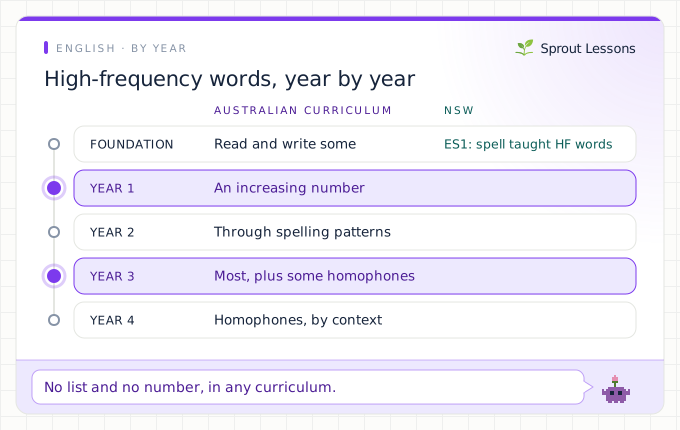
High-frequency words sit in the literacy strand, beside phonics. The descriptors, quoted from ACARA:
- Foundation, AC9EFLY14: “read and write some high-frequency words and other familiar words”. Some, not a set number; and familiar words such as your child’s own name count too.
- Year 1, AC9E1LY14: “read and write an increasing number of high-frequency words”.
- Year 2, AC9E2LY11: “use knowledge of spelling patterns and morphemes to read and write words whose spelling is not completely predictable from their sounds, including high-frequency words”. The key phrase is “not completely predictable”: partly predictable, in other words.
- Year 3, AC9E3LY12: “recognise and know how to write most high-frequency words including some homophones”. Year 3 writing also expects “correct spelling of most high-frequency and phonetically regular words” (AC9E3LY06).
- Year 4, AC9E4LY11: “read and write high-frequency words including homophones and know how to use context to identify correct spelling”. Their, there and they’re; to, too and two.
There are no high-frequency word descriptors after Year 4. By then the words should be so familiar that they are read without effort, and the job is fluency, which reading comprehension by year picks up.
Where Victoria differs (the VCAA wording is paraphrased here, not quoted). The Victorian Curriculum version 2.0 matches level by level: some high-frequency words at Foundation (VC2EFLY07), more at Level 1 (VC2E1LY07), spelling patterns and morphemes for partly predictable words at Level 2 (VC2E2LY05), most of them plus some homophones at Level 3 (VC2E3LY06), and homophones with context at Level 4 (VC2E4LY05). What changed is the earlier version. The old Level 1 descriptor (VCELA184) asked children to use visual memory to write high-frequency words, with look-say-cover-write-check as the suggested method. Version 2.0 drops visual memory and ties the words to phonics and spelling patterns instead, which is why your child’s school may teach them differently from the way an older sibling learnt them.
Where NSW differs (the NESA outcomes are paraphrased). NSW has no separate high-frequency word outcome. The words appear once, in the Kindergarten spelling outcome, which asks children to spell taught familiar and high-frequency words using phonological, orthographic and morphological strategies (ENE-SPELL-01). From Stage 1 they are folded into spelling and into reading fluency, where Kindergarten reads decodable texts aloud with automaticity (ENE-REFLU-01). So in NSW, too, they are treated as words to decode and spell, not shapes to memorise.
How a “tricky” word actually works
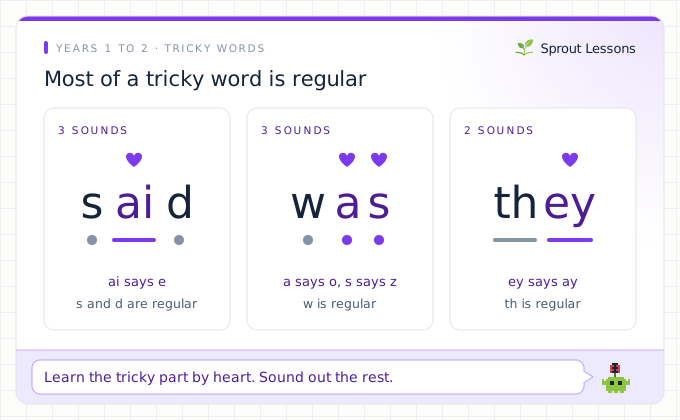
Take “said”. It has three sounds: s, then a short e, then d. The s and the d are exactly what a Prep child expects. Only the middle is odd, because the letters ai, which usually say the sound in rain, here make the e sound. So there is one thing to remember, not four letters in a strange order. The same goes for “was” (the a says o, the s says z), “they” (th is regular, ey says ay) and “the” (th is regular; the e is usually a quick, soft sound).
Teachers often call the odd part the “heart” part, because it has to be learnt by heart, and many draw a small heart over it. That is what the Year 2 descriptor means by words “not completely predictable from their sounds”. And plenty of the most common words have no odd part at all: and, it, in, can, but, got, had, him, them. They only need phonics.
Is the list from school wrong, then? No. Schools use word lists for good reasons: they choose which words to teach first, and a list is easy to send home. Read it as a list of words to learn properly, not a list of shapes to memorise, and use the method below. Our page on phonics by year covers the letter-sound side these words lean on.
Five mistakes that tell you where your child is
1. Guessing from the first letter (Foundation to Year 1)
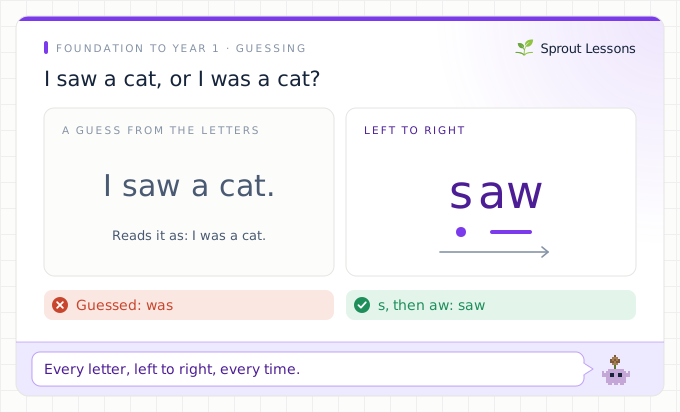
Your child reads “went” as “want”, “three” as “there”, or “saw” as “was”. They are recognising a word by its first letter and rough shape, which works until two words look alike. The fix is to slow down and look at every letter: run a finger under the word left to right and say each sound. It feels like a step backwards. It is the step that makes the word stick: once each letter in a word has been linked to its sound, the word is far easier to recognise the next time.
2. Fifty words on flashcards, no letter sounds (Foundation)
Some children arrive in Term 2 of Prep able to say lots of words from a flashcard ring, and unable to read a new word like “pig”. Whole-word memory has a ceiling, because every new word is a new shape. The curriculum asks for “some” high-frequency words in Foundation alongside a sound for every letter, and the phonics is what carries a child past the list. If your child knows many words by sight but cannot sound out a simple three-letter word, put the flashcards aside for a few weeks and spend the time on letter sounds and blending.
3. Right in the list, wrong in the book (Year 1)
A child reads “the”, “was” and “said” perfectly on a list, then stumbles on all three in a story. The words are learnt, but not yet automatic: in a book, attention is split between words and meaning. The fix is volume of easy reading, not more lists. Decodable books, written with the sounds your child has been taught, are full of these words. Re-reading the same book three or four times across a week builds the speed.
4. Spelling “sed” and “wos” (Years 1 and 2)
This is a good mistake. A child who writes “sed” has heard every sound in “said” correctly and spelt it the regular way. They have the phonics; they are missing only the heart part. Praise the sounds, then show the one change: “you’ve got s and d right; in this word the e sound is spelt ai.” That is AC9E2LY11 at work, and it is far quicker than starting the word from scratch.
5. Their, there and they’re (Years 3 and 4)
By Year 3 most children read these instantly and still write the wrong one. They are homophones: same sound, different spelling and meaning, and the curriculum adds them in Year 3 and asks children to choose by context in Year 4 (AC9E3LY12, AC9E4LY11). The fix is one hook per word. There has “here” inside it, and both are places. Their is about owning something: their dog, their bikes. They’re is always “they are”: read the sentence with “they are” and see if it still works. For more on the writing side, see spelling by year.
A two-minute check
Write each word on its own card. Ask your child to read it, then to write it from memory with the card hidden. Stop at the first row that goes wrong.
- Foundation: I, a, is, it, in, and. Then: can they sound out a word they have not seen, such as “pog”? (A made-up word shows decoding, not memory.)
- Year 1: the, was, said, they, to, of. Ask which part of each word is the tricky bit.
- Year 2: could, would, should, because, people, friend. Do they spot that could, would and should share a pattern?
- Year 3: there, their, two, too, right, write. Read a sentence aloud for each and ask which spelling fits.
- Year 4: they’re, where, wear, whether, weather, piece. Write one sentence that uses two of them correctly.
Reading a word but not writing it is normal, a year or so behind, because spelling from memory is harder than recognising. Not reading it at all is the gap to work on.
Want practice set in their world? Sprout writes an English lesson on AC9E1LY14 or AC9E4LY11 around what your child loves, from dinosaurs to netball. Try it free.
Ten minutes, three words at a time
Three new words a session is plenty. For each one:
- Say it and use it. Say the word, then a sentence with it in. “Said. Mum said it was time for bed.”
- Count the sounds. Tap a finger for each sound you hear: s, e, d is three.
- Match letters to sounds. Write the word with a dot or line under each sound. Find the part that does not match the usual sound and draw a small heart over it.
- Write it three times, saying the sounds as you write, then once more with the card hidden.
- Find it in a book. Hunt for the word on a page of something your child is reading. Seeing it in a sentence is what makes it automatic.
Keep the cards in two piles, “learnt” and “still working”, and check the learnt pile once a week. Words move back if they slip.
What is not the problem
- Not knowing “100 words” by the end of Prep. No curriculum sets a number. A child who knows a sound for every letter, can blend simple words and reads some common words is meeting the Foundation descriptors.
- Sounding out “said” slowly in Term 1 of Year 1. Slow and right comes before fast. Speed comes from reading lots of easy text.
- A school list that differs from a friend’s school. Each school picks its own. The common words overlap heavily, whatever the list is called.
Where this sits
High-frequency words lean on phonics by year, and their spelling side is in spelling by year. In Victoria the letter-sound knowledge behind them is checked in the Year 1 Phonics Check, and the Prep picture is in what a child should know by the end of Prep. The teacher-facing Year 1 English codes list every Year 1 descriptor. If you are not sure which curriculum applies, start with which curriculum your state uses.
The short version
- The curriculum says “high-frequency words”, never “sight words”, and sets no list or number.
- Foundation: some. Year 1: more. Year 2: through spelling patterns. Year 3: most, plus homophones. Year 4: homophones by context.
- Most tricky words have one odd part. Learn that part by heart and sound out the rest.
- Guessing from the first letter, and lists without letter sounds, are the habits to break early.
- Victoria and NSW treat the words the same way; Victoria’s old visual-memory approach has gone.
Sprout makes a lesson on the exact code your child is working on, set around what they love. Start free.
How this page was checked
The Australian Curriculum descriptors are quoted from our copy of version 9.0, which matches AC9E1LY14 on the Australian Curriculum website; we searched every Foundation to Year 10 English descriptor for high-frequency, sight and irregular words. The Victorian codes are from the Victorian Curriculum F–10 version 2.0, and the earlier Level 1 descriptor from the archived version 1.0 content description VCELA184. The NSW outcomes are from the NSW English K–10 Syllabus outcomes, Early Stage 1 to Stage 2. Victorian and NSW wording is paraphrased. The example words in the checks were chosen for this page and are not an official list. Checked 1 November 2026.
Australian Curriculum content descriptions are © Australian Curriculum, Assessment and Reporting Authority (ACARA) 2010 to present, licensed under CC BY 4.0, and quoted here unmodified. ACARA does not endorse any product that uses the Australian Curriculum. Victorian Curriculum codes reference the Victorian Curriculum F–10 Version 2.0 © VCAA, paraphrased; the VCAA does not endorse this product. NSW outcome codes reference the NSW syllabuses © NSW Education Standards Authority (NESA) for and on behalf of the Crown in right of the State of New South Wales, paraphrased, available at curriculum.nsw.edu.au; NESA does not endorse this product.
FAQ
How many sight words should a Prep child know?
No Australian curriculum sets a number. The Australian Curriculum asks Foundation children to read and write "some high-frequency words and other familiar words" (AC9EFLY14), and Victoria says the same (VC2EFLY07). Lists such as a school's first 100 words are the school's choice. Knowing a sound for every letter and being able to blend simple words matters more than the size of the list.
What is the difference between sight words and high-frequency words?
High-frequency words are the words that appear most often in text, such as the, and, said and was. "Sight words" usually means words a child reads instantly, by sight. The curriculum uses only "high-frequency words", and from Year 2 it treats them as words with spelling patterns, most of them only partly irregular.
What are heart words?
A teaching name for the part of a common word that does not follow the usual letter-sound pattern and has to be learnt by heart. In said, the s and d are regular and only ai (saying e) is tricky. Children sound out the regular parts and remember the heart part, often marked with a small heart.
Why does my child read was as saw?
Because they are recognising the word from its letters as a group rather than reading them left to right. Was and saw use the same three letters. Running a finger under the word and saying each sound in order is the fix, and it usually clears within a few weeks.
When do kids learn their, there and they're?
Homophones enter the Australian Curriculum in Year 3 (AC9E3LY12, most high-frequency words including some homophones), and Year 4 asks children to use context to choose the correct spelling (AC9E4LY11). Reading them correctly comes well before writing the right one every time.